AI operations manager
Orbyte
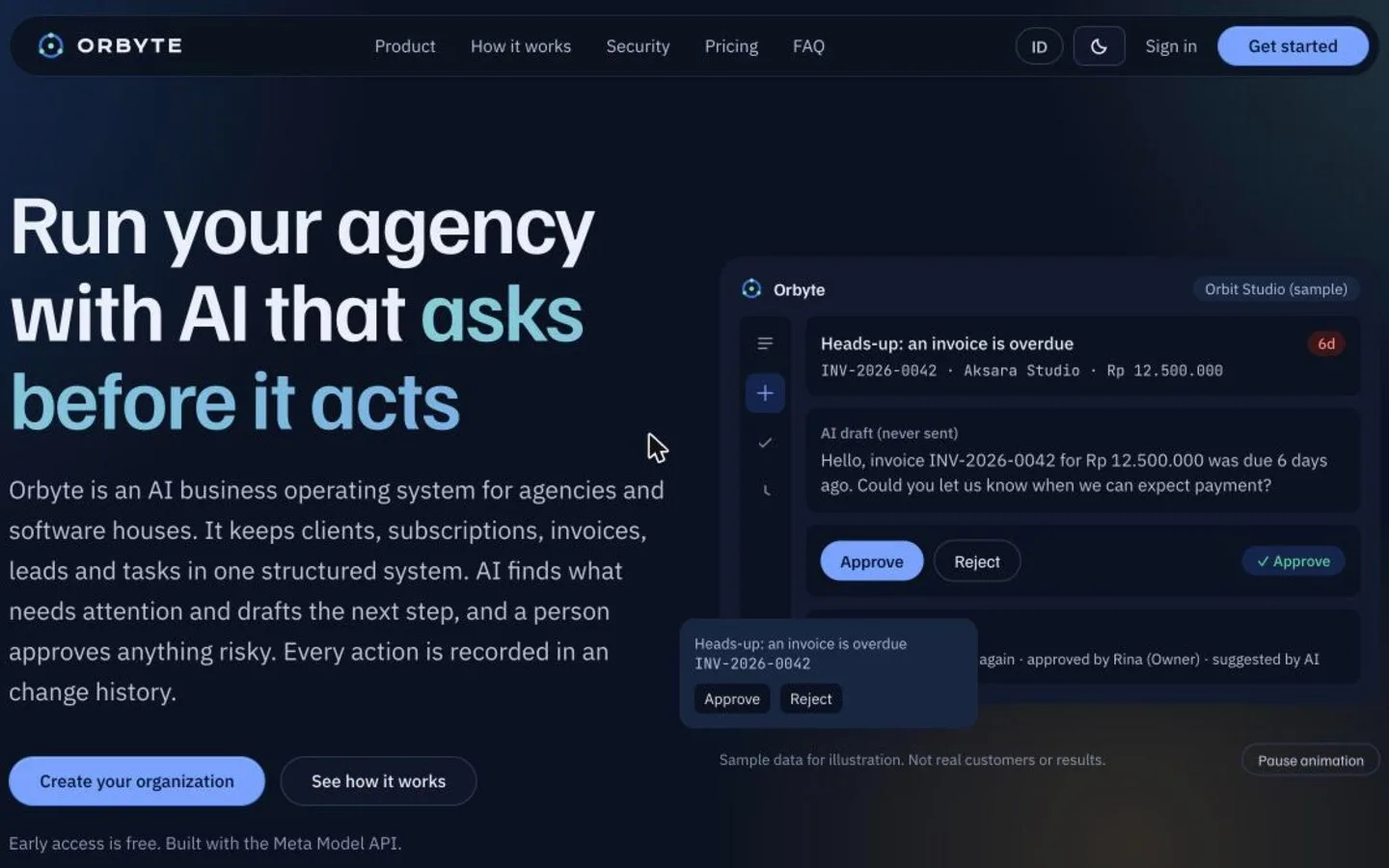
An operating system for software agencies: clients, subscriptions, invoices, leads and tasks in one place. The AI spots what needs attention and drafts the next step, and a person approves anything risky. Built for the Meta Global AI Developer Hackathon.
The problem
Agencies juggle clients, subscriptions, invoices, leads and tasks across several tools, and an AI that changes money or documents without supervision is a risk.
What it does
- A chat assistant with typed tools: some only read, some draft, and “act” tools create an approval card before anything changes.
- Modules for clients, packages, subscriptions, invoices, leads, tasks, documents and meetings.
- An append-only audit log and an AI usage log with tokens and cost per call.
- A Telegram bot, voice transcription, image generation and narrated video rendering.
- A deployment flow editor and uptime checks for client deployments.
How it is built
- Astro 7 with React 19 and TypeScript; Drizzle on PostgreSQL; better-auth with multi-tenant organisations; Tailwind 4.
- Meta’s Model API for chat, images and speech.
- Started on 28 October 2026 for the Meta Global AI Developer Hackathon and reached 64 commits in eight days.
How AI is used
- Meta Muse models: muse-spark for chat and agent steps, muse-image for images and muse-voice-transcribe for speech.
- Used for the assistant, company profiles filled in from a website, web research, marketing posters, meeting notes and video scripts.
Honest notes
- Built in about a week for a hackathon, so it is a production-quality prototype rather than a long-running product.
- No CI pipeline yet; the test counts in the README were not re-run.
Engineering depth
Counts taken from the repository itself, not performance claims.
- 48
- database tables
- 29
- migrations
- ~119
- test files
- 64
- commits in 8 days